
How Fairview Health Services Built a Culture of Patient Experience Ownership
CONTENTS
What makes it challenging for Fairview leaders to consistently use patient feedback to drive improvement? →
How did Fairview build leader ownership of patient experience data? →
What changed as leaders became more comfortable with the data? →
How did Fairview help leaders move from insight to action? →
What does patient experience ownership look like today? →
Can you share an example of a team using feedback to drive improvement? →
How did patient experience become an organization-wide resource? →
How a seven-person customer experience (CX) team got leaders across a 36,000-employee health system to act on patient experience.
Patient experience improvement doesn’t happen overnight, especially in a health system with 36,000 employees, 12 hospitals, 10 emergency departments, and 15 urgent care locations.
At Fairview Health Services, a seven-person CX team supports leaders across a large, decentralized organization. Over time, the team has evolved from helping leaders access patient feedback to building a culture where leaders proactively use experience insights to drive improvement themselves.

We sat down with Sathya Chandran, Senior Insights Business Analyst at Fairview Health Services, to discuss that journey. “We needed to build trust on the data. NRC Health data is the most accurate and the most reliable data.”
Key takeaways:
- A seven-person CX team scaled its impact across a 36,000-employee health system by building a network of embedded CX Pacesetters.
- Building ownership required more than data access. Fairview focused on trust, purpose, training, and co-designed tools that helped leaders turn insight into action.
- As leaders gained confidence, patient experience shifted from a centralized responsibility to a proactive, organization-wide capability.
- For example, an outpatient imaging team used patient feedback to identify communication gaps, implement a simple, informational card, and improve likelihood-to-recommend scores from approximately 89 to 92-93 in six months.
We sat down with Sathya Chandran, Senior Insights Business Analyst at Fairview Health Services, to discuss that journey. “We needed to build trust on the data. NRC Health data is the most accurate and the most reliable data.”
Fairview is a large and complex health system. What makes it challenging for leaders to consistently use patient feedback to drive improvement?
Sathya: The biggest challenge is time and competing priorities.
Leaders are balancing staffing, operations, quality, safety, and patient experience all at the same time. They have a lot on their plates.
We also support a very large system with a relatively small team. We have about seven people supporting a health system with 36,000 employees. Because of that, our role has always been helping leaders consume information in a way that is easy to understand and act on.
How did Fairview build leader ownership of patient experience data?
Sathya: We didn’t become what we are today overnight.
We took it one step at a time.
The first thing we focused on was building trust. We wanted leaders to trust the data and understand that the feedback represented real experiences and opportunities for improvement.
We also connected the work back to purpose. No one comes to work wanting to do a bad job. Everyone wants to provide the best possible care. Connecting leaders to the “why” behind patient experience helped build engagement.
Steps to build ownership
- Build trust in data.
- Connect the work to purpose.
- Expand access through CX Pacesetters.
- Train and support continuously.
From there, we expanded access. We created a CX Pacesetter network because our seven-person team could not support 36,000 employees on our own. The Pacesetters serve as patient experience champions embedded throughout different care settings across the organization.
We provided them with access to NRC Health, data, training, deep dives, and ongoing support. They serve as local champions for patient experience improvement.
As those fundamentals became established, we continued expanding support through refresher courses, hands-on learning, provider coaching, and practical resources. If leaders identified an opportunity in the data, we wanted them to know what actions they could take and where they could find support. Those investments helped build the foundation for the next stage of our journey.
What changed as leaders became more comfortable with the data?
Sathya: The questions changed.
Initially, leaders wanted to understand how to access information, subscribe to reports, and interpret what they were seeing.
Over time, they started asking more advanced questions.
The question became: “Okay, I see this data. What next?”
That was a really important shift.
We saw leaders becoming more sophisticated in how they used the data. They were ready to go deeper. They wanted help understanding opportunities, identifying priorities, and determining what actions to take next.
Leaders no longer needed help finding information. They wanted help understanding how to act on it. That was when we realized our role had to evolve as well.
How did Fairview help leaders move from insight to action?
Sathya: One thing we learned is that not all leaders were at the same stage of the journey.
Some leaders were still learning the fundamentals, while others were ready for more advanced support. We had to meet people where they were.
For those ready to go deeper, we worked with NRC Health to co-design dashboards, templates, reports, and other resources to make the data easier to understand and act on. Using NRC Health’s API capabilities and custom reporting, we gave leaders new ways to monitor performance, explore patient journeys, identify opportunities, and better understand the experiences of the communities we serve.
“NRC Health data has become much more than just a score for us. It gives leaders practical ways to explore what’s happening, dig deeper, and focus improvement efforts where they’re needed.” –Sathya Chandran, Senior Insights Business Analyst, Fairview Health Services
Rather than trying to build everything at once, we took a phased approach, continuing to refine and expand resources based on leader feedback and organizational needs.
The goal was always the same: helping leaders move from data to insights and from insights to action.
Examples of how Fairview is putting patient experience data to work:
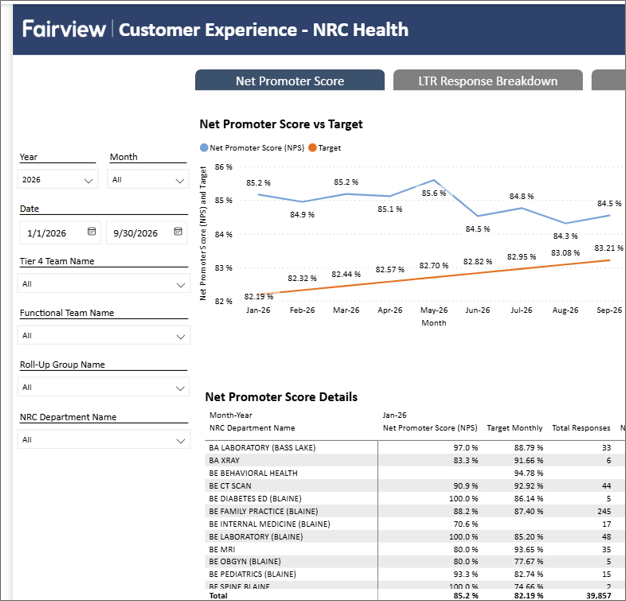
See performance & opportunities
Using NRC Health’s API, Fairview developed a PowerBI dashboard that lets leaders track LTR/NPS against targets and drill down by location and department.
Click image to enlarge
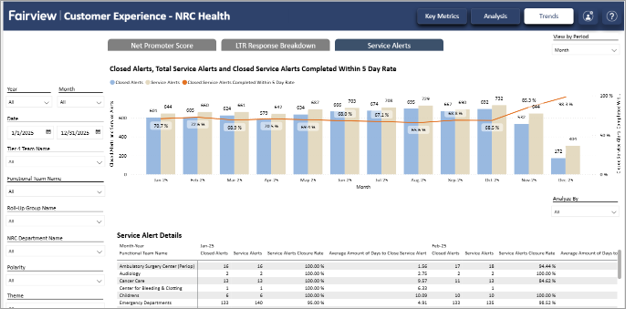
Monitor service recovery
A service alert dashboard gives teams visibility into follow-up performance, including alerts closed within one and five business days, with the ability to explore patterns across locations and alert themes.
Click image to enlarge
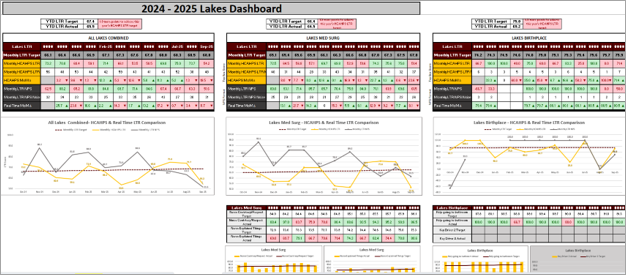
Spot trends and opportunities
Operational Excel dashboards built using NRC Health’s custom reporting capabilities, bring together LTR, key drivers, trends, and location comparisons to focus attention where it’s needed.
Click image to enlarge
What does patient experience ownership look like today?
Sathya: We built it one step at a time, starting with trust, access, training, and support. As leaders became more confident, the responsibility gradually shifted from our team to theirs.
In the past, many of the follow-up questions came back to our team. Leaders would ask us to help explain demographics, benchmarks, response rates, or additional data points.
Now they know where to go.
They understand which reports will help answer specific questions and how to explore the data more effectively. They know how to connect quantitative metrics with patient comments and other supporting information.
They also come to meetings differently.
They’re more prepared. They anticipate questions. They are ready to explain what’s happening, why it’s happening, and what actions they’re taking as a result.
The biggest shift we’ve seen is that patient experience is no longer something leaders react to after the fact. It’s become much more proactive.
Can you share an example of a team using feedback to drive improvement?
Sathya: One example that comes to mind is our outpatient imaging team. They are highly engaged with the data. They look at it regularly, read every comment, and share patient comments within their team.
When they saw their scores beginning to dip, they reached out to us. We completed a deep dive together, looking at the questions we needed to ask and the reports that could help us answer them. We found that one of the team’s biggest opportunities was helping patients know when to expect their test results.
The imaging team received leadership approval, formed a work group, and brought the appropriate stakeholders together to explore potential solutions. Because imaging studies vary, patients could experience different timelines and next steps depending on the type of study.
The team created a small, portable card that patients could easily take with them. One side included expected result timelines for common imaging studies and explained whether results would appear in MyChart or be communicated by phone. The other side provided a phone number for patients to call if they had questions or did not hear back. Ultimately, it was all about setting clear expectations for patients about what would happen next and when.
The card was a huge hit. The team’s likelihood-to-recommend NPS was approximately 89 before the intervention and increased to approximately 92 or 93 in the following six months. Patient comments specifically mentioned appreciation for the cards. The team also saw improvement in the measure related to knowing when to expect results, as well as significant improvement in knowing what to do next.
The success did not stop with imaging. A similar strategy was implemented in outpatient laboratory services, where the team has also seen a positive impact. Sharing these examples across Fairview has created a ripple effect. Teams can see that when they identify a problem, partner with the right people, and act on the data, they can achieve tangible results.
How did patient experience become an organization-wide resource?
Sathya: When I stepped into this role around 2021, many people in the organization didn’t even know the customer experience team existed.
Today, that’s completely different.
Teams across the organization actively use patient experience data. Teams across Fairview, from clinical areas to departments like IT, finance, and HR, now use patient experience insights to answer questions, support projects, and identify opportunities for improvement.
What started as a focus on building trust and access has evolved into something much bigger. Patient experience data has become an organizational resource that teams use to understand challenges, identify opportunities, and drive improvement.

Related Resource
From Signal to System: Experience Management Everywhere
Check out this nSight to see how NRC Health compared 41 organizations, revealing five interconnected dimensions of effective experience management.
Related Resource
From Signal to System: Experience Management Everywhere
Check out this nSight to see how NRC Health compared 41 organizations, revealing five interconnected dimensions of effective experience management.

Let's Get Social
Want to follow the Human Understanding movement? Check out NRC Health on social media.

